The basement firm
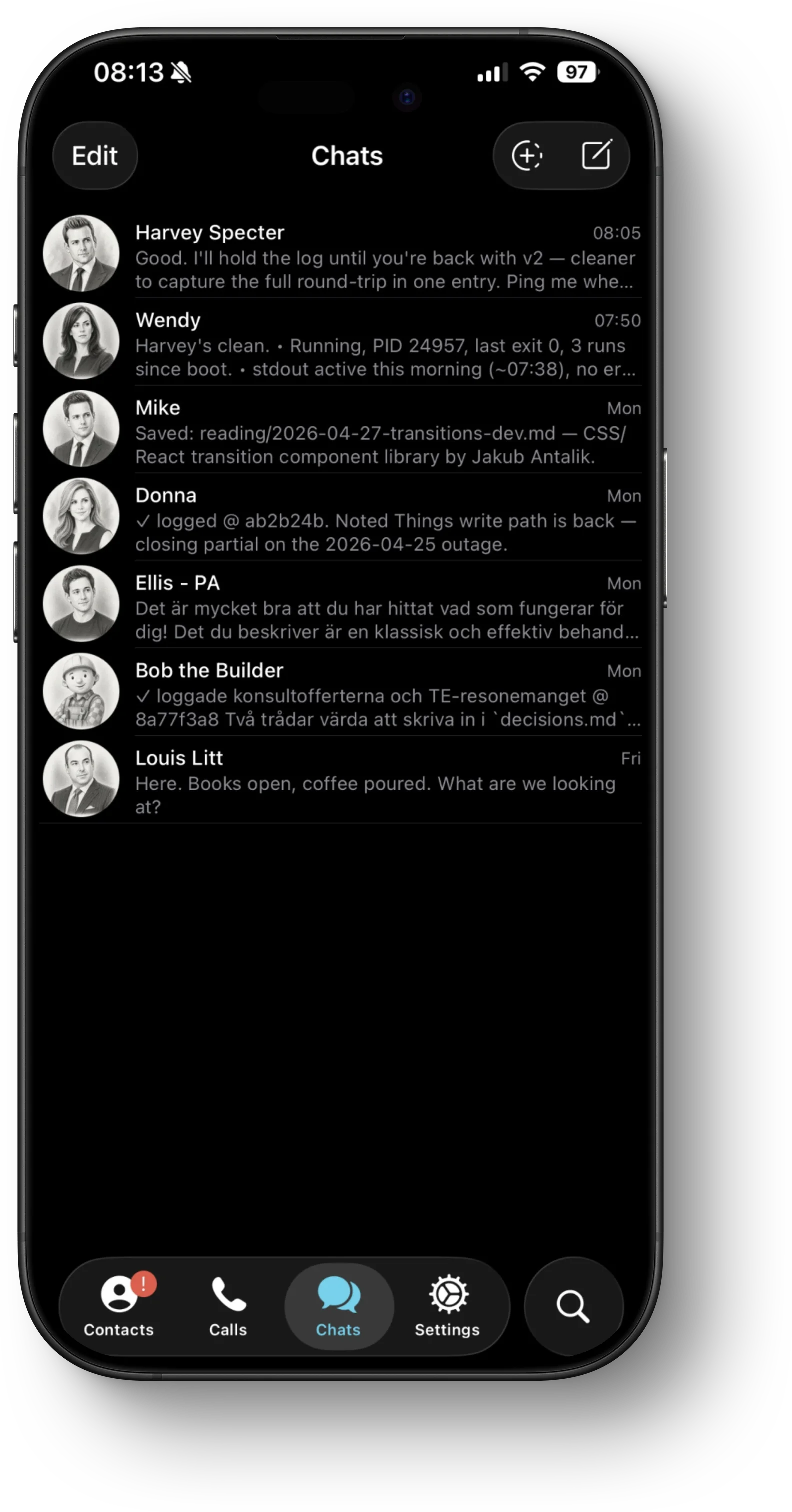
There’s a Mac mini in my basement running a small consulting firm. Five employees, all named after TV characters, none of them human. They take notes, write drafts, remember things I’ve forgotten, argue with my financial instincts, and occasionally tell each other to do better.
It’s the most fun I’ve had with my work in a long time.
Why names
I tried a few of the personal AI assistant platforms before this — OpenClaw, Hermes. Impressive projects, both of them. But I never quite figured out when to reach for them versus just opening Claude. With OpenClaw especially, the setup was days, sometimes weeks, for minutes of return.
What I actually wanted was smaller. A handful of tools, each with a narrow job, that I could build in an afternoon and shape around how I actually work.
So that’s what I did. And then, because I couldn’t help myself, I gave them characters.
The Suits roster was the obvious pick. I’ve watched the show enough times that the personalities are baked in — Harvey is the closer, Donna runs the show, Mike has the photographic memory, Louis is… well, Louis. Slotting them into system prompts wasn’t strategy. It was a memory aid that happened to make the agents more enjoyable to work with.
The roster
Harvey is my career coach. Contracts, scope, pricing, the awkward conversations with clients. When I’m about to undercharge or say yes to something I should say no to, Harvey is the one who tells me to read the room. After every call with him, he writes his notes to harvey-log.md.
Donna picks up where Harvey leaves off. She reads his log and helps me turn the rough thinking into actual writing — emails, follow-ups, sometimes blog drafts. She uses my anton-voice skill, trained on everything I’ve published, so the output sounds like me on a good day rather than a competent stranger telling me I’m absolutely right about everything. The handoff between Harvey and Donna is the smallest part of the setup and also the part I use most.
Mike is memory. Anything I’d otherwise lose — articles I want to come back to, places I want to visit, ideas at 11pm — gets sent to Mike. Months later, when I’m thinking about something adjacent, he surfaces it.
Louis handles money. Cash flow, what to invest, what to leave in the bank, when to be patient. He’s anxious in exactly the way a financial advisor should be. I don’t always take his advice, but I’ve stopped making decisions about money without running them past him first.
Wendy is the newest. I couldn’t find a perfect fit from Suits, so I pivoted to another favorite show, Billions. She went live today. Her job is to coach the rest of the team — she reads the logs the others produce and flags patterns, gaps, things they could be doing better. An agent whose job is to make the other agents better.
How they actually work
There’s no orchestration framework, no clever multi-agent architecture. Each one is a Claude Code instance running on the Mac mini. They share a repo. They write markdown files. That’s the connective tissue.
Harvey writes his log. Donna reads it. Mike’s memory is an iCloud folder with subfolders for articles, images, YouTube summaries, plus a Supabase database where he logs the wines I enjoy and the places I want to visit. Wendy reads everyone’s logs and suggests improvements.
The whole thing is shockingly simple, and I think that’s why it works. The interesting part isn’t the technology. It’s that I can hand off between specialists instead of asking one giant generalist to do everything badly.
What this is not
Most posts about AI agents right now are pitching some version of the same fantasy — a team of bots that runs your business while you sleep. Autonomous revenue. Set it and forget it.
That’s not what this is.
The team in my basement isn’t running anything autonomously. They don’t make decisions for me. If I unplugged the Mac mini tomorrow, my business would keep running.
The conflation in the current AI conversation — between playing and building a thing that prints money — is the part I find a bit tiring. They’re treated as the same activity, when they’re almost opposites. Playing is about exploring without knowing where it ends up. Autonomous revenue is the most goal-oriented thing imaginable. You can do both, but pretending one is the other does a disservice to both.
On play
I’m having more fun designing than I’ve had in a long time. More empowered too. Every week I can do things I couldn’t do a year ago, and the gap keeps widening.
The agents are part of that. So is messing around with Claude Code (more on that soon), building tools nobody asked for, prototyping things I’d never have bothered to prototype a year ago. None of it is on a timesheet.
That said, I’d argue this is the business case for designers right now. Not the agents specifically — the playing. Because in a year or two, every job worth having is going to assume you understand how these tools work, and the only way to understand them is to spend time in them when nothing’s on the line.
The people who’ll do interesting work with this stuff in two years are the ones playing with it badly today.
Will AI take our jobs as designers anytime soon? I don’t think so. And even if it does, I’m going to enjoy this stretch as long as it lasts.
Back to the basement
The Mac mini is still humming away as I write this. Harvey is idle. Donna is mid-draft. Mike is sitting on a few hundred things I’ve sent him. Louis is quietly judging my coffee budget. Wendy is reading everyone’s logs, taking notes on her first day.
A small consulting firm in the basement. Named after fictional lawyers and a hedge fund therapist. Not running my business. Just keeping me curious.